Two Eras,
One House:
Staging an 1895 Townhome
With a Glass Addition
112 N Harvie Street is half 1895 brick and timber, half two-story glass. Staging had one job: make it read as one house.
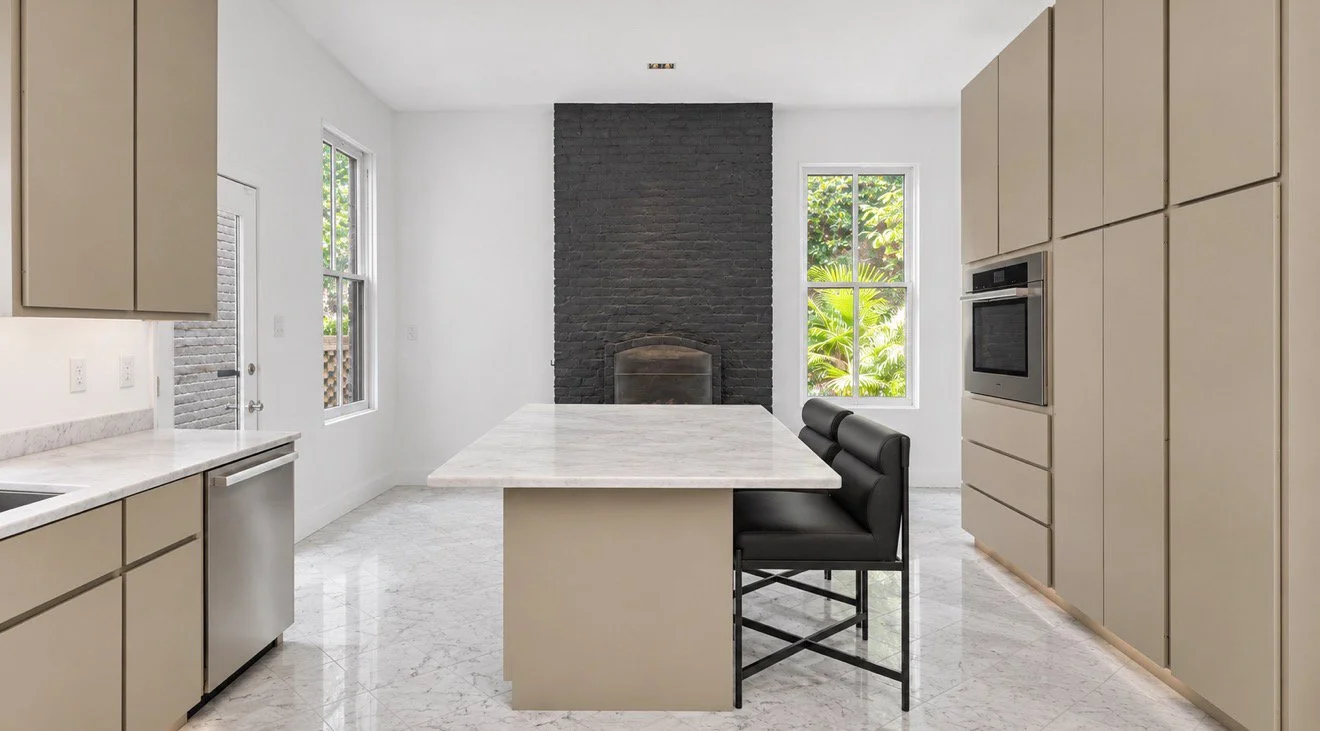
Some houses have a split personality, and buyers feel it the moment they walk in. 112 N Harvie Street in the Fan is one of them, in the best way. The front half is pure 1895: exposed brick, exposed ceiling timbers, dark wood floors. The back half is a two-story space wrapped in tall glass walls, opening to a private courtyard. The kitchen runs Miele appliances over a Carrara marble floor. It's a remarkable renovation. From a buyer's point of view, it's also two very different houses sharing one address.
Why Two Eras Can Cost a Seller
That's a staging problem with real money attached. When a home's two halves don't speak to each other, buyers subtract. They fall for one era and discount the other. Or they read the contrast as a renovation that didn't know what it wanted to be.
An empty house makes it worse. In the Fan, where rooms are narrow and ceilings are tall, empty rooms look smaller and more confusing than they are.
How We Staged It to Tell One Story
In the historic rooms
we furnished to honor the proportions, with pieces that let the brick and timbers stay the point.
In the glass addition
we showed how the space actually lives. A two-story glass room is spectacular in theory and puzzling in person until furniture tells you what happens there.
Listing agent Chris Small of Park 27 has sold homes in the Fan and Museum District for more than four decades, and he puts it plainly:
"Small updates and fresh paint don't add much value on their own. What they do is take away doubt."
Chris Small, Park 27A buyer who sees scuffed trim starts adding up repair costs in their head, and their number is always higher than the real one. The same is true for a whole floor plan. Staging removes the doubt about whether the house makes sense.
The Result
This one made sense fast. It listed at $869,950 on August 31, had an accepted offer four days later, and sold on October 12 for $935,000, about $65,050 or 7.5 percent over asking. That's $411 per square foot on 2,276 square feet.
One more number worth noticing: the same home sold for $736,000 in May 2022. That's $199,000, or 27 percent, in four years, on a footprint that didn't change. The market helped. Preparation and presentation did the rest.
If your home mixes old and new, our guide to selling a renovated home and our vacant home staging page explain how we plan it. The press release on 112 N Harvie Street has the full details.
Thinking about selling? Start with Ready-Set-Sold®. Call (804) 239-9845 or visit jsquaredrva.com.
Frequently Asked Questions
Stage both halves to tell one story. At 112 N Harvie Street, an 1895 Fan District townhome with a two-story glass addition, Jsquared furnished the historic rooms to honor their proportions, showed how the glass addition lives, and carried a shared palette between them. The vacant home sold for $935,000, $65,050 (7.5%) over asking.
Fan District rooms tend to be narrow with tall ceilings. Without furniture, buyers have nothing to judge scale by, so rooms read smaller and the layout reads more confusing than it is. Staging gives each room a size and a purpose.
Mostly they remove doubt. Buyers who see scuffed trim or dated fixtures estimate repair costs higher than the real ones. Small updates take that discount off the table.
Jsquared Interior Staging & Design, 1908 E Main St, Richmond, VA 23223, (804) 239-9845, stages vacant homes in the Fan, the Museum District and across a 150-mile radius of Richmond.